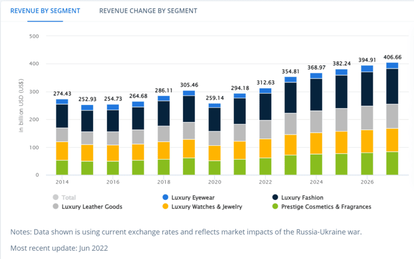
Luxury is an attractive industry thanks to its large size, rapid growth despite the economic crisis, and attractive margins. According to Statista Forecast, the global luxury goods market will be worth US$312.60 billion by 2022. The market is expected to grow by 5.40% p.a. (CAGR 2022-2027).
In today's globalized economies and markets, luxury goods are manufactured through highly complex global supply chains involving numerous stakeholders ranging from small, highly specialized suppliers closely controlled by large brand owners. For example, very specific raw materials or parts are sourced in one country and processed in another before assembly of the final product takes place in a third country - which the luxury brand owner then distributes to its customers worldwide. In the luxury goods industry, supply chain management is crucial to business success.
The complexity of luxury companies' supply chains is facing unprecedented challenges given the volatility of consumer tastes and spending, shortened product life cycles, growing international trade compliance requirements and customer demand for sustainability and transparency. Significant trajectory shifts in the global business environment - from the geopolitical conflicts of the trade war, Brexit, to U.S. tax reform and the renegotiation of the North American Free Trade Agreement to new agreements like the Comprehensive and Progressive Trans-Pacific Partnership Agreement - combined with more stringent enforcement laws and regulations against corruption(see FCPA) and profit transfer practices(see BEPS) increase the interdependence of the wide range of complex risks facing the luxury industry, which often lacks the tools, processes and resources to manage emerging risks effectively.
The global outbreak of COVID 19, worldwide city closures, delayed delivery times, factory and store closures, and the cancellation of trade shows and fashion events have significantly disrupted luxury supply chains.
Traditionally, personalization, customer focus and the in-store retail experience have differentiated luxury from traditional retail. While this remains true, as physical channels make up the largest share of market value, alternative sales channels such as internet sales and alternative business models such as luxury resale are taking off. By 2021, the value of the online personal luxury market was estimated at €62 billion. This upward trend is fueled by many historic names in the luxury industry venturing into online sales channels. Over the past three years, the Kering group's online sales have risen from 7% to 15%, for example. The Richemont Group's online retailers, which include Watchfinder and the renowned online marketplace for luxury goods Yoox Net-a-Porter, have delivered over two billion euros in 2021.
Driven by the need to adopt more sustainable production and consumption measures in recent years, resale has also emerged as a profitable and viable option for luxury. By 2021, the second-hand luxury market was estimated to be worth 33 billion euros worldwide.
All these uncertainties of supply and demand have weakened the resilience of the luxury supply chain, making it almost impossible for the supply chain manager to have reliable sales and supply forecasts. The luxury industry's trade compliance team or subject matter experts (where available in-house) strive to mitigate their luxury brands' international trade compliance risks augmented by any or all of the following external and internal pressures :
- Outsource globally to stay competitive while expanding global and alternative distribution channels. Just as global trade compliance functions lack visibility of local activities, many lack knowledge of trade compliance risks in different regions and countries. It is often difficult to manage the compliance obligations of offshore trade, suppliers in terms of standards, ethics, product definition and quality controls. They need to ensure that all transactions comply with their own country's export regulations and import controls at the final destination before goods are shipped, to avoid disrupting customs border controls, fines and penalties. Monitoring the trade laws and regulations applicable to each luxury brand, including the trade barriers impacting the competitiveness of their business, is a cumbersome activity that is often hampered by resource constraints far more focused on business continuity.
- Global security initiatives - the trade compliance team/expert needs to understand the data issues required by customs authorities and other government agencies that demand much greater transparency on the organization's fiscal responsibility, business processes, information systems and internal controls to manage trade compliance and supply chain security risks. All too often, trade compliance functions find it difficult to articulate the strategic value they deliver through qualitative measures involving their relationship-focused activities such as relations with customs authorities, government agencies, banks, suppliers, customers, brokers, agents, freight forwarders as well as any internal departments such as R&D, purchasing, sales, customer service, finance, tax, human resources, legal affairs, public affairs, auditing, and so on. any business compliance program that the authorities regularly monitor to assess the consistency of the company's corporate governance with global security risks. Luxury brands can no longer hide behind window-dressing commercial compliance policies and must "follow their lead" by demonstrating to the satisfaction of the supervisory authority that their commercial compliance programs are effectively implemented, monitored and supported. To verify the effectiveness of these processes and controls, the trend towards peer-to-peer internal self-assessment is growing. Recent years have also seen an increase in the number of organizations engaging in internal or external audits to ensure that their trade compliance controls are well designed and effectively deployed.
- Increasing liability risks for directors and officers now put trade compliance on the board agenda given the significant financial impact of international trade compliance on the luxury industry and their growing exposure to personal liability. The main concerns of luxury brand companies are reputational damage and liability risks related to bribery, corruption, adverse media, export controls, sanctions while facing the challenges of improving tax transparency with reliable country-by-country reporting and voluntary disclosure when irregularities are discovered. Reputation is a luxury brand's greatest asset - but it can also be the most difficult to manage, due to the difficulty of measuring and mitigating it, unlike any traditional risk category.
- Trade compliance functions most often report to supply chain or logistics functions, but increasingly report to finance, tax or other functions (e.g. purchasing or compliance officers), bearing in mind that responsibility is spread across several departments and that the desired reporting structure varies from one organization to the next. Fortunately, the rise of dedicated, centralized trade compliance leadership at enterprise level and the rise of trade compliance shared service centers show that trade compliance functions around the world are maturing, enabling them to strengthen governance, control global standard setting, leverage local solutions, and share knowledge.
- Lack of visibility on customs duties and clearance costs at country level. It seems that many luxury brand organizations have not yet developed the systems and processes necessary to enable effective global monitoring of their local customs activities, agents, duty payments and, above all, the reliability of their trade reference data. Unlike indirect tax functions, which are largely part of the wider tax function and benefit from proven accounting reporting processes, there is no single structure emerging for the governance of trade compliance functions, let alone a centralized platform to monitor and report on the performance of their customs activities and the quality of their trade master data.
- Managing what is still a highly error-prone and paper-intensive process, luxury brands tend to outsource their customs and trade compliance operations - often to third-party or fourth-party logistics providers (3PLs and 4PLs) diluting their customs clearance costs in their transport spend without clear oversight of the performance, spend and overall accountability of their clearance activities. Only a minority of these functions have defined metrics to monitor their performance. Without specific metrics and quality data to support them, commercial compliance functions are unable to determine or demonstrate their value to the organization. As a result, global trade functions may struggle to justify future investments in the technology, automation and processes needed to help realize their potential. The most common performance measures are the reduction of customs expenses, the reduction of customs clearance costs, cost avoidance with interest minimization, penalties as well as the accuracy of import/export declarations and the timely submission of declarations. Other export control measures focus on the number of potential results against sanctioned refused parties, the timely classification of customs and export controls of newly introduced materials, the validation of potential results, sanctioned transactions blocked or released in a timely manner, and so on.
- Dealing with a lack of qualified in-house trade compliance expertise and a hiring freeze in the trade compliance function weakens the fragmented organization, with stand-alone luxury brand companies operating their own legacy supply chain systems, activities and processes. Failure to proactively integrate trade compliance team or expert consultation into their sourcing and commercial strategy - can result in reactive efforts to mitigate trade compliance issues after trade changes, transfer pricing adjustments impacting duty liability and lost customs planning opportunities. While there is no one-size-fits-all trade compliance organization, and some trade compliance processes may be better managed locally, experience suggests that a centralized model should not necessarily cover all trade compliance activities. A combination of local and central processes can potentially offer greater benefits, depending on the individual processes involved and their suitability for automation.
Looking ahead, BIG FOUR consultancies expect companies to move towards a more outsourced model in the coming years, as indirect tax functions are already doing by outsourcing more and more activities so that they can leverage the technology investments and economies of scale of third-party service providers and focus more on strategic activities and added value.
Investing in technology and resources
Only a small majority of large luxury companies use global trade management software and technologies to manage certain aspects of their import/export activities. The smaller the company, the lower the use of global trade management software.
When such solutions are in place, they are mainly used for :
- export and import with confidence
- improve legal intelligence with reliable business content
- improve the quality of trade data through automated customs classification, qualification for the benefits of free-trade agreements and compliance with rules of origin
- leverage the efficiency of operational processes such as customs valuation, customs clearance and collaboration with customs brokers
- boost ratios and power analysis
- maintain compliance in all global operations by effectively monitoring customers, suppliers and other partners against worldwide lists of denied parties.
MyTower sees a strong appetite from the luxury goods industry to invest in digitizing trade compliance in the near term. Technology is at the top of the investment priority list, and trade compliance managers are increasingly building compelling business cases for these investments. They understand all too well how technology can leverage the capabilities and performance of their trade compliance and risk management processes. Luxury brands are striving for more resilient supply chain models based on :
- A solid foundation of commercial compliance and reliable commercial reference data*.
- Technology that enables the seamless exchange of information using up-to-date business content, control and visibility over their global business operations, and a powerful collaborative platform that significantly reduces the risk of non-compliance.
- Tracking and optimizing commercial compliance efficiencies
*The diagram below shows the main trade reference data affecting international trade compliance.