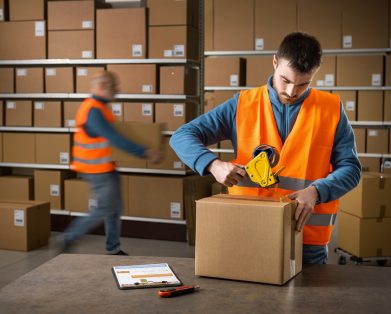
Commercial companies of all sizes are faced with ever-changing freight costs. Sea freight, air freight and road haulage are all directly affected by geopolitical events, and the current period is sure to shake up the sector. For example, when fuel prices rise sharply, the transport budget can explode too. Yet this expense item is rarely kept under control as it should be, mainly due to the choice of the best tool. Let's see how a TMS (Transport Management System) can considerably reduce the transport budget while optimizing organization.

Keep a close eye on the transport budget
Depending on the company and the period, the transport budget can vary between 3% and 10% of total expenditure. In any case, it remains too high an expense column for many companies. Added to this are the difficulties of checking invoicing lines, and the time that transport department employees sorely lack to find and remedy faults.
Cost control, or more precisely cost visibility in the transport sector, is part of the quest for competitiveness. This is an essential challenge, and one that can be met with the right tools to drive improvement.
What can be done to limit transport costs?
For shippers, it is important to focus on the various aspects that mechanically reduce costs:
- Limit the number of kilometers driven
- Optimizing resources
- Improve truck fill rates
- Consolidate shipments
- Control and optimize waiting times
- Consolidate flows
- Better purchasing and sourcing
- Choosing your service providers
- Reduce disputes
- Controlling additional and negotiated costs
- Etc.
Added to this is the management of payroll and time spent on time-consuming tasks such as typing, sending e-mails and document management.
What is a TMS and why is it useful for cutting costs?
A Transport Management System (TMS) is a software package for managing all your transport operations. Previously used only by logistics and transport companies themselves, in recent years it has demonstrated its effectiveness upstream: in other words, with shippers.
A TMS enables you to manage the transport of your goods from A to Z, from the creation of deliveries to reporting, including route optimization and carbon footprint management. It is also a complete cost management tool, enabling :
- Automation and optimization of operations
- Cost and invoice control
- Load simulation for better purchasing
Automate and optimize your transport operations with a TMS
Automation is often the key to lower costs. This is particularly true in the transport sector, where it is possible to reduce the number of loads to be organized. To achieve this, the TMS adapts the fill rate and number of kilometers based on your order book, saving you as much transport as possible. It's even possible to view a 3D simulation of loads to reduce empty space, which represents both a financial and ecological cost.
Benefit from a cost and invoice control system
The TMS is also an excellent internal auditor of your freight invoices. Once again, this is made possible by automatic control of invoices, including errors and discrepancies, even for complex modes of transport.
Generally speaking, this dedicated transport management tool enables you to control your expenses by tracking all payment stages, from pre-invoicing to logistics flows.
Simulate your transport purchases for better control
By equipping your organization with a TMS, you can carry out a budget simulation upstream of your transport decisions. It integrates all your criteria and service levels (volume, rates, CO², etc.), enabling you to compare tenders and make the best choice of service providers.
In this way, you can secure your operations according to different assumptions, which may be based on your historical data. A TMS also enables you to carry out multi-dimensional analyses, all on an intuitive, comprehensive dashboard that generates your reports.
The integration of a TMS such as MyTower TMS has an immediate and quantifiable impact on the transport budget, with a possible reduction of 20%. Implementing a TMS enables you to control expenses through automatic monitoring, and reduce costs thanks to budget simulation, load optimization and tour management modules. All in all, a TMS provides a visible and immediate ROI, and genuinely reduces your transport costs.