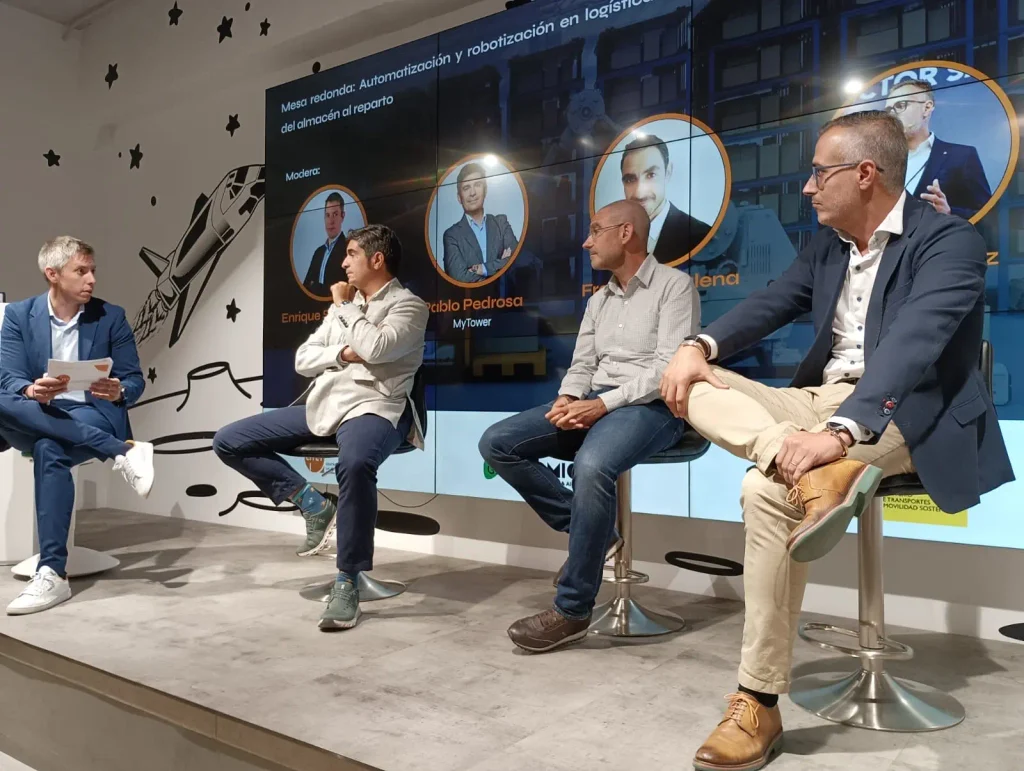
On September 17, 2026 , Pablo Pedrosa, Key Account Manager at MyTower, participated in the panel discussion “Automation and Robotics in Logistics: From the Warehouse to Delivery,” held as part of the #LogisticsTrends technical conference at MIOTI in Madrid.
Organized by CITET, a partner of MyTower, this event focused on artificial intelligence, automation, robotics, and digital twins as they apply to the distribution of goods.
Moderated by Enrique Sánchez of CITET, the panel discussion also featured Fran Magdalena, CEO of Tookane, and Aitor Madoz, Global Operations Director at UNOde50.
MyTower is a European group specializing in supply chain execution, bringing together several companies with expertise in transportation, visibility, and logistics digitization, including TDI, which has a strong presence in the Spanish market.
In light of the enthusiasm surrounding artificial intelligence, Pablo Pedrosa advocated for a pragmatic approach. In his view, technology creates value only when it is based on clearly defined processes and reliable data. And not everything that can be automated should necessarily be automated.
To illustrate his point, he began his remarks with a cinematic metaphor:
“A company’s logistics are like *Pulp Fiction*. You see processes that no one understands, that seem to have no connection to one another. But when you step back and look at the big picture, everything makes sense: they’re interconnected and form a system that works very well.”
Process, Data, and the Client's Final Decision
For Pablo Pedrosa, automation depends on two prerequisites: a well-defined process and actionable data.
“You need a defined process and data. With an order, a destination, a rate, and objective rules, the system can automatically assign a carrier,” he explained.
Before qualifying his statement: “It’s possible, but it’s not necessarily desirable.”
In particular, he mentioned customs tariff classification projects in which clients prefer that artificial intelligence make recommendations rather than make decisions on its own.
"Ultimately, it's about having a tool that can automate certain tasks when you want it to, and not automate them when you don't."
This approach highlights the importance of maintaining control over processes and allowing companies to choose the level of automation that best suits their needs.
Reporting a problem does not mean solving it
Regarding the evolution of logistics control towers, Pablo Pedrosa emphasized a key distinction: reporting a problem is not the same as solving it.
Artificial intelligence agents already make it possible to transmit real-time information on the progress of operations. However, entrusting them with the autonomous resolution of incidents still raises questions, particularly in uncontrolled environments involving physical constraints.
To illustrate this limitation, he gave the example of a vehicle breakdown during an urban delivery route:
“If a delivery van breaks down and an email is sent to everyone announcing that the package will be 30 minutes late, is that really a solution? The real solution would have been for the package to arrive on time.”
In such a situation, it is necessary to identify the orders being transported, determine which other vehicle could take over the route, or assess whether it would be better to wait for the repair.
All of these decisions require a comprehensive understanding of operations and their constraints.
According to Pablo Pedrosa, the most complex operational decisions must therefore continue to be subject to human validation.
He believes that there will “always need to be someone behind the scenes to verify or approve” these decisions.
According to him, full automation will only be possible once decision-making processes have been sufficiently standardized.
More demanding customers and ever-shorter deadlines
When asked about how business expectations have evolved, Pablo Pedrosa pointed out that customers’ fundamental needs have not really changed over the past fifteen years.
They are always looking for “a solution that works and solves their problems.”
On the other hand, their level of knowledge and expectations has changed significantly, as has the pressure to speed up projects and shorten deployment timelines.
However, this focus on speed can become counterproductive when it leads to neglecting elements that are essential to a project’s success.
Pablo Pedrosa thus warned of the risk that certain initiatives might never truly take off if all the necessary factors were not taken into account from the very beginning.
Automation and Employment: A Social and Structural Transformation
The roundtable discussion also addressed the impact of automation on employment and changes in logistics professions.
To illustrate the scale of this transformation, Pablo Pedrosa compared the current situation to the advent of the printing press:
"It's like introducing the printing press to a group of scribes."
According to him, automation will lead to job losses in certain sectors and force society to reinvent itself, both socially and structurally, with transformations whose full consequences are still difficult to imagine.
He nevertheless pointed out that physical labor and human judgment will remain essential in many situations.
In particular, he cited the example of a supermarket equipped with an automated warehouse that delivered yogurt and cheese in separate bags.
A telling example: automating a process does not necessarily make it more efficient or more sustainable.
In conclusion, Pablo Pedrosa reaffirmed the need to preserve the role of people in organizations:
“Behind all of this are people. Let’s make sure these people remain important and that their work can continue, because some issues cannot be solved by technology.”
About MyTower
MyTower is a European group specializing in supply chain execution, comprising MyTower, TDI, Winddle, and Belharra e-SCM.
Together, these companies share a common goal: to build an end-to-end, connected supply chain that is managed in real time and is intelligent and predictive.
Their integrated platform covers the entire process, from collaboration with suppliers through international trade, customs management, and transportation to final delivery.